Showing posts with label Psychiatric symptoms. Show all posts

Monday, 3 September 2018

News from the Land of Milk and Honey

I had the good fortune to attend a conference on Precision Medicine and Ageing today. This brought some of the leading scientists from the UK and Israel together, as part of the British Council’s Britain Israel Science and Innovation Network. The day included speakers talking about the latest breakthroughs in genomics, neuroscience, cellular biology and many other fields of scientific endeavour and how they relate to the biology of ageing (in health as well as disease) and how these breakthroughs are bringing us closer to the ‘promised land’ of Personalised, or Precision medicine.

The talk that I found the most interesting came from Dr Maya Leventer-Roberts, from the Clalit Research Institute. This is not a university department, but the in-house research arm of the largest of Israels four health providers. They have an unparallelled treasure-trove of health data. She explained that all Israeli citizens belong to one of these four organisations who provide all aspects of care: GP, pharmacy, testing laboratories, hospitals – you name it. What’s more, very few people change providers, so they have a well-coded database of people’s wellness, illness and health behaviour at all stages of life.

I have since found a paper from last year which uses some of their data to examine a relatively neglected aspect of Parkinson’s – depression. Unfortunatley a huge proportion of people with Parkinson’s struggle with depression. We also know that late onset depression is a risk factor for Parkinson’s. 

In this study, they looked at mortality rates in Parkinson’s and the association with how adherent people were with antidepressents. They analysed the data of 10,000 people with a diagnosis of Parkinson’s as well as at least one prescription of an antidepressant. They then categorised people into how frequently they tookthe antidepressants by comparing their prescriptions from the doctor with the number of purchases of antidepressants from the pharmacies. Finally they looked at death by any cause over the 4 year study period.

They found that the people who had Parkinson’s and depression who took their antidepressants the least were 43% more likely to die within the 4 year period, compared to those who took it the most regularly. The increased mortality was exacerbated by having an increasing number of other medical problems.

I must stress the old adage: association does not equal causation. This kind of retrospective observational study cannot provethat one thing causes another. However, it is an important reminder that depression is an important aspect of Parkinson’s, and that poorly managed depression is associated with increased mortality. It also reminds me that older people, with Parkinson’s, depression and perhaps four or five other medical conditions may be on 15-20 or more tablets a day. What can I do as a clinician to help them remember what each is for, and why each is important to take? What can we do as a society to help people with depression with both drug and non-drug treatment options? How can we better prepare ourselves, individually and societally, for ageing and the only true inevitability of life?

RNR

Shoval G, Stubbs B, Balicer RD, Feldman B, Hoshen M, Zalsman G, et al. 
Low adherence to antidepressants is associated with increased mortality in Parkinson disease patients. 
Parkinsonism Relat Disord. 2017 Oct;43:92–6.


INTRODUCTION:The purpose of this study was to evaluate the relationship between adherence to antidepressants (AD) and all-cause mortality in a population-based cohort of patients with Parkinson's Disease (PD).

METHODS:From a database of more than 4 million people, 8553 patients with PD who purchased an AD at least once between the years 2008-2011 were retrospectively followed for all-cause mortality over 4-years. Adherence was measured as a ratio between dispensed and prescribed durations and was modeled as: non-adherence (<20%, n = 1566), poor (20%-50%, n = 1184), moderate (50%-80%, n = 1584), and good (>80%, n = 4219) adherence. Multivariable survival analyses adjusted for demographic and clinical variables including physical comorbidities known to influence mortality were conducted, however there was no adjustment for other psychiatric disorders and medications.

RESULTS:Unadjusted mortality rates were 20.4%, 25.1%, 23.4% and 25.6% in those classified as non-adherent, poor, moderate and good adherence respectively (χ2 = 18.45, p < 0.0001). The non-adherent and poor adherence groups had significantly increased adjusted mortality hazard ratios (HR) of 1.43 (CI: 1.26-1.62) and 1.26 (CI: 1.1-1.44) respectively compared to the good adherence group. Using the same model, the adjusted HR for death among males was 1.49 [95% CI: 1.36-1.62] compared to females. People with PD and Charslon's Comorbidity Index score of 3-4 (HR 1.3, P < 0.001) and 5+ (HR 1.78, P < 0.001) were more likely to die than those with 0-2 comorbidities.

CONCLUSIONS:Our findings suggest that poor adherence to AD is associated with increased all-cause mortality in people with PD. Given the high prevalence of depression and AD effectiveness, efforts to promote adherence should be prioritized in clinical practice.

Friday, 23 March 2018

The Parkinson's Phenome: Traits Associated with Parkinson's Disease in a Large and Deeply Phenotyped Cohort

This is one of the first collaborative endeavours between Karl Heilbron (23andMe) and I... and I hope one of many. I have to say Karl did the bulk of the leg work and I was grateful for the opportunity to help pull it all together...

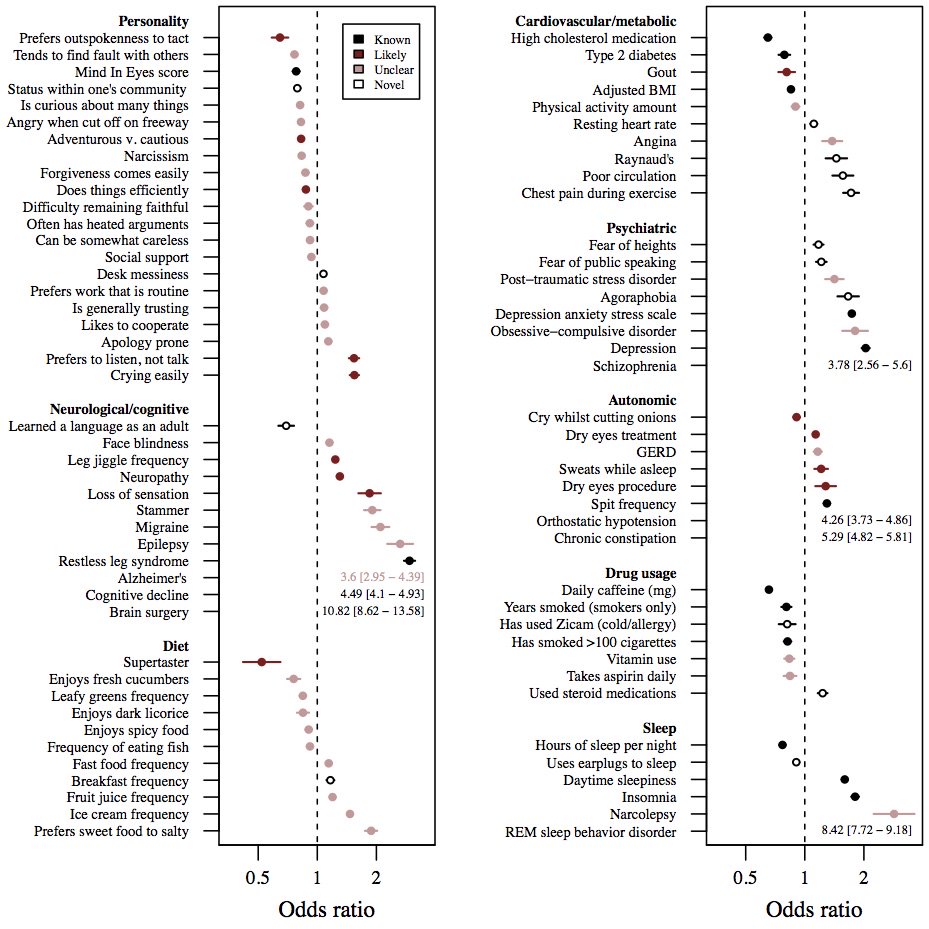
These data from 23andMe offer unparalleled opportunity to explore reported associations with Parkinson's. Using a rigorous pipeline for selecting phenotypic traits (self reported health conditions, dietary preferences, non-motor symptoms etc) we were able to produce an incredibly detailed exploration of the Parkinson's phenome (the sum total of Parkinson's associated traits). One of the fascinating things about the results is that many of the traits are instantly recognisable to those of us that see patients with Parkinson's regularly... this in turn increases our confidence about the novel associations that we observed and which offer further avenue for further research.

Additionally, where possible each trait was tested to if it was associated with disease duration, thereby suggesting that it might be a manifestation of disease rather than a risk factor or prodromal feature. Of course cross-sectional data has limitations when it comes to understanding cause and effect, but for the clinical neurologist seeing patients with PD this report of co-existing symptoms, behaviours and related health conditions could have huge practical use. The plan is to make all analyses available in order to stimulate further research in this area...

- Alastair Noyce

Karl Heilbron, Alastair Noyce, Pierre Fontanillas, Babak Alipanahi, The 23andMe Research Team, Mike Nalls, Paul Cannon

doi: https://doi.org/10.1101/270934

https://www.biorxiv.org/content/early/2018/02/28/270934

Background
Observational studies have begun to characterize the wide spectrum of phenotypes associated with Parkinson's disease (PD), but recruiting large numbers of PD cases and assaying a diversity of phenotypes has often been difficult. Here, we set out to systematically describe the PD phenome using a cross-sectional case-control design in a large database.

Methods
We analyzed the association between PD and 840 phenotypes derived from online surveys. For each phenotype, we ran a logistic regression using an average of 5,141 PD cases and 65,459 age- and sex-matched controls. We selected uncorrelated phenotypes, determined statistical significance after correcting for multiple testing, and systematically assessed the novelty of each significant association. We tested whether significant phenotypes were also associated with disease duration in PD cases.

Findings
PD diagnosis was associated with 149 independent phenotypes. We replicated 32 known associations and discovered 49 associations that have not previously been reported. We found that migraine, obsessive-compulsive disorder, seasonal allergies, and anemia were associated with PD, but were not significantly associated with PD duration, and tend to occur decades before the average age of diagnosis for PD. Further work is needed to determine whether these phenotypes are PD risk factors or whether they share common disease mechanisms.

Interpretation
We used a systematic approach in a single large dataset to assess the spectrum of traits that were associated with PD. Some of these traits may be risk factors for PD, features of the pre-diagnostic phase of disease, or manifestations of PD pathology. The model outputs from all 840 logistic regressions are available to the research community and may be used to generate hypotheses regarding PD etiology.

Funding
The Michael J. Fox Foundation, Parkinson's UK, Barts Charity, National Institute on Aging, and 23andMe, Inc.

Wednesday, 13 December 2017

Detecting anxiety in individuals with Parkinson disease: A systematic review

This is a new systematic review of studies assessing the diagnostic accuracy of anxiety scales in people with PD. It is important because anxiety is a common feature of Parkinson's both before and after the diagnosis. The authors found that overall 30% of people with Parkinson's meet the criteria for anxiety, but I have to say that in my experience I would put it closer to 50%. Maybe this reflects a bias in the patients I see??

The properties of the scales available for assessing anxiety are important. At the beginning of PREDICT-PD, we went through a pain-staking process of selection and in the end arrived at the Hospital Anxiety Depression Scale (HADS). In fact, at that time we knew that it was not the very best Anxiety scale or the very best Depression scale in terms of diagnostic accuracy, but it did combine assessment of both problems in one validated questionnaire, it was feasible to self-administer and it was relatively short. Nearly seven years on I am still happy with that decision but we may now test other scales within the PREDICT-PD programme too. Depression and anxiety are two features that are likely to pre-date a diagnosis of PD by a long time and it is critically important to be using the best tools to identify them both. They also have a dramatic impact on quality of life and are treatable, which are two good reasons to be trying to pick them up in people that don't have a diagnosis because there are likely to be significant health benefits...

Alastair Noyce

Neurology. 2017 Dec 6. pii: 10.1212/WNL.0000000000004771. doi: 10.1212/WNL.0000000000004771. [Epub ahead of print]
Mele B, Holroyd-Leduc J, Smith EE, Pringsheim T, Ismail Z, Goodarzi Z.

http://n.neurology.org/content/early/2017/12/06/WNL.0000000000004771.long

OBJECTIVE: To examine diagnostic accuracy of anxiety detection tools compared with a gold standard in outpatient settings among adults with Parkinson disease (PD).

METHODS: A systematic review was conducted. MEDLINE, EMABASE, PsycINFO, and Cochrane Database of Systematic Reviews were searched to April 7, 2017. Prevalence of anxiety and diagnostic accuracy measures including sensitivity, specificity, and likelihood ratios were gathered. Pooled prevalence of anxiety was calculated using Mantel-Haenszel-weighted DerSimonian and Laird models.

RESULTS: A total of 6,300 citations were reviewed with 6 full-text articles included for synthesis. Tools included within this study were the Beck Anxiety Inventory, Geriatric Anxiety Inventory (GAI), Hamilton Anxiety Rating Scale, Hospital Anxiety and Depression Scale-Anxiety, Parkinson's Anxiety Scale (PAS), and Mini-Social Phobia Inventory. Anxiety diagnoses made included generalized anxiety disorder, social phobia, and any anxiety type. Pooled prevalence of anxiety was 30.1% (95% confidence interval 26.1%-34.0%). The GAI had the best-reported sensitivity of 0.86 and specificity of 0.88. The observer-rated PAS had a sensitivity of 0.71 and the highest specificity of 0.91.

CONCLUSIONS: While there are 6 tools validated for anxiety screening in PD populations, most tools are only validated in single studies. The GAI is brief and easy to use, with a good balance of sensitivity and specificity. The PAS was specifically developed for PD, is brief, and has self-/observer-rated scales, but with lower sensitivity. Health care practitioners involved in PD care need to be aware of available validated tools and choose one that fits their practice.

Monday, 30 October 2017

On Thinking and Feeling

Sarah Getz and Bonnie Levin have published a broad and wideranging review of cognitive and neuropsychiatric symptoms in early PD.

The bottom line of this article underscores the tennet that PD is not just a movement disorder!

Although a noticeable proportion of people with PD may develop dementia, a significant body of work has shown that even at the earliest stages (including the prodromal or pre-motor stages), there are detectable memory deficits. One particular aspect of difficulty is in ‘executive function’ – the thinking process that allows for planning, initiating and concentrating on a task as well as ‘thinking outside the box’. I think this has interesting significance when considering the daily function of people with Parkinson’s, such as driving (see an earlier blog post from the PREDICT-PD blog).

Depression, fatigue and apathy are all very common symptoms that have a major impact on the quality of life of people with PD, not to mention their family and caregivers. Fatigue has been reported to occur in up to 2 in every 3 people with PD and has been described as the most debilitating symptom. Apathy is a real danger – muscles, be they physical, cognitive or emotional, need use. Apathy robs the person of the drive to exercise those muscles and thereby jeopardises their future ability to move, think and feel as they once did. It goes hand in hand with depression and also with increasing disability do to PD.

As we learn more about these less visible aspects of PD, we now need to search for ways to treat them. This is particularly important as the bedrock of PD treatment may make some aspects of thinking and feeling worse.

RNR


Cognitive and Neuropsychiatric Features of Early Parkinson's Disease.
Getz SJ, Levin B.
Arch Clin Neuropsychol. 2017 Nov 1;32(7):769–85. 

The clinical definition of Parkinson's disease (PD) is based on cardinal motor features including bradykinesia as well as an additional symptom of tremor, postural instability, or rigidity. Evidence from neuropathological, imaging, and clinical research suggests a premotor, early phase of PD pathology. Further understanding of the earliest biomarkers of PD is crucial for the development of neuroprotective, disease modifying, cognitive, and psychiatric interventions. Recent research has explored early non-motor markers of PD pathology. This issue is especially timely as the International Parkinson and Movement Disorder Society has recently provided a research definition for prodromal PD which includes combinations of prodromal markers and risk factors aimed at identifying target populations for disease-prevention trials. In this review of early PD, we will outline early non-motor symptoms, early cognitive and neuropsychiatric features, neuropsychological assessment strategies, emerging evidence for early biomarkers, and treatment recommendations.


Friday, 20 October 2017

What's in a name? Parkinson's Disease (Lewy bodies subtype) vs Lewy Body Dementia

This is a timely paper given ongoing questions about nomenclature in Parkinsons. Previously, people who developed dementia and then problems with movement were classified as having dementia with lewy bodies, whereas those who developed dementia after their initial movement problems were given a diagnosis of Parkinson's Disease dementia. For those who develop both problems around the same time, the diagnostic label can feel quite arbitrary. The MDS guidelines in 2015 challenged this paradigm by allowing for a diagnosis of Parkinson's disease in the context of dementia - suggesting the term PD (dementia with Lewy bodies subtype). 

But more recently the DLB consortium brought out specific guidelines for diagnosis of DLB - suggesting we still use this diagnostic term where dementia occurs before or concurrently with parkinsonism. They do acknowledge that "in practice the term that is most appropriate to the clinical situation should be used and generic terms such as lewy body disease may be helpful". 

Classifying both diseases along the same continuum is largely in keeping with their underlying pathophysiology. Both are characterised by lewy body inclusions of alpha-synuclein protein in the brain - and are likely to be different outward manifestations of the same underlying process. A further line of evidence for this is that rapid eye movement sleep behaviour disorder, which confers increased risk of both diseases, is also now recognised to be characterised by lewy body pathology. 

In this paper in JNNP, authors from Bologna aimed to look at the validity of guidelines for diagnosis of DLB, performing a systematic review and meta-analysis of papers in which the authors had corroborated the clinical diagnosis with pathological assessment of brain tissue. They included studies with over 1500 patients and looked at diagnostic criteria over time, finding overall that with revised criteria over time, the sensitivity (likelihood of correct diagnosis) increased but specificity (likelihood of not having the disease after being given the diagnosis) declined. We seem to be picking up more of the people who truly have the disease but also diagnosing more people with the disease who don't have it. 

Part of the problem is overlap of clinical symptoms - some patients with Alzheimer's disease present similarly to those with dementia with lewy bodies. But the study also underlines the issues with our classification, some of those 'misdiagnosed' had Parkinson's Disease. If we start to consider both as part of a spectrum of lewy body diseases Parkinson's wouldn't be a misdiagnosis - which challenges both our conceptions of disease (clinical vs pathological entity) and diagnosis. What do you think?

-Anna


Accuracy of clinical diagnosis of dementia with Lewy bodies: a systematic review and meta-analysis

Giovanni Rizzo, Simona Arcuti, Massimiliano Copetti, Maria Alessandria, Rodolfo Savica, Andrea Fontana, Rocco Liguori, Giancarlo Logroscino

Background 
The diagnosis of dementia with Lewy bodies (DLB) is based on diagnostic clinical criteria, which were updated over the years.
Objective 
To evaluate, through a systematic review, accuracy of the diagnostic criteria, testing a possible improvement over time.
Methods 
We searched on MEDLINE and SCOPUS databases for studies reporting diagnostic parameters regarding the clinical diagnosis of DLB until October 2016. We performed meta-analysis, using a Bayesian approach, on those using pathological examination as gold standard, subclassified based on the different diagnostic criteria used.
Results 
We selected 22 studies on 1585 patients. Pooled sensitivity, specificity and accuracy were 60.2%, 93.8%, 79.7%, respectively, for criteria antecedents to McKeith 1996. For McKeith 1996-possible, pooled sensitivity, specificity and accuracy were 65.6%, 80.6%, 77.9% in early stages and 72.3%, 64.3%, 66% in late stages, respectively. For McKeith 1996-probable, pooled sensitivity, specificity and accuracy were 19.4%, 95.1%, 77.7% in early stages and 48.6%, 88%, 79.2% in late stages, respectively. McKeith criteria 2005 were evaluated only in late stages: pooled sensitivity, specificity and accuracy were 91.3%, 66.7% and 81.6%, respectively, for possible diagnosis (only one study) and 88.3%, 80.8%, 90.7% for probable diagnosis, decreasing to 85.6%, 77.1% and 81.7% if only considering clinical settings focused on dementia diagnosis and care.
Conclusions and relevance 
Diagnostic criteria have become more sensitive and less specific over time, without substantial change in the accuracy. Based on current data, about 20% of DLB diagnosis are incorrect. Future studies are needed to evaluate if the recently released revised consensus criteria will improve the diagnostic accuracy of DLB.


Friday, 29 September 2017

On dopamine and depression

Image result for dopamine happy
                                                 How true is this in Parkinson's???

We are learning ever more about the manifestations of non-motor symptoms in Parkinson's Disease and their presence from even before diagnosis. It's fair to say that for many patients, it's actually the non-motor symptoms rather than the motor symptoms that cause much of the burden of the disease. To effectively target these symptoms it's vital that we understand the underlying cause. 

Neuropsychiatric symptoms (e.g. depression, anxiety, hallucinations) have been assumed to be directly linked with dopamine dysregulation - the same process leading to movement problems.  It makes sense - dopamine regulating drugs can be an effective treatment for people with schizophrenia so dopamine is already implicated in neuropsychiatric symptoms. 


However, there are other potentially blame-worthy processes going on in the course of Parkinson's Disease and teasing out their contributions is the aim of this paper, from a team based in South Korea. The authors looked at a group of newly diagnosed Parkinson's patients who were assessed clinically for neuropsychiatric symptoms then had PET scans specific for the dopamine activity and MRI to look more globally at brain atrophy. 


The first important finding was that a high proportion, almost 60% of patients, had at least one neuropsychiatric symptom. The imaging results paint an intriguing picture, with thinning (neuronal loss) in specific areas being linked to specific symptoms - for example temporal lobe atrophy was associated with aggression/agitation. Dopamine activity, on the other hand, was not linked with any of the symptoms.

There are some issues with the kind of exploratory analysis in this study - when a lot of comparisons are made it is likely that, by chance, there will be some positive results. It is also important to consider that there are likely links between the different neuropsychiatric symptoms that mean they can't be considered independently of each other. But I think it's an important reminder that, just as Parkinson's is more than just a movement problem, it's underlying cause is more than a dopamine problem.  

-Anna

https://www.ncbi.nlm.nih.gov/pubmed/28951497

J Neurol Neurosurg Psychiatry. 2017 Sep 26. pii: jnnp-2017-316075. doi: 10.1136/jnnp-2017-316075. [Epub ahead of print]

Effects of dopaminergic depletion and brain atrophy on neuropsychiatric symptoms in de novo Parkinson's disease.

Ye BS, Jeon S, Yoon S, Kang SW, Baik K, Lee Y, Chung SJ, Oh JS, Moon H, Kim JS, Lee PH, Sohn YH.

Abstract

BACKGROUND:

Neuropsychiatric symptoms impact the patients' quality of life and caregivers' burdens in Parkinson's disease (PD). We aimed to investigate the effects of striatal dopaminergic depletion and brain atrophy on the neuropsychiatric symptoms of patients with PD.

METHODS:

Two hundred and seven patients with de novo drug-naïve PD underwent dopamine transporter (DAT) positron emission tomography and brain MRI scanning. In addition, the patients were assessed with caregiver-administered neuropsychiatric inventory (NPI) questionnaires. To evaluate the effects of DAT uptake, subcortical volume and cortical thinning on the patients' neuropsychiatric symptoms, we performed logistic regression and negative binomial regression analyses on the NPI data after controlling for possible confounders.

RESULTS:

Frontal cortical thinning was associated with the presence of nighttime behaviour and irritability, and the thinning correlated with the severity of the nighttime behaviour. Temporal cortical thinning was associated with the presence of aggression/agitation, and it correlated with the severity of the aggression/agitation. Subcortical atrophy in the accumbens was associated with the presence of disinhibition and correlated with the severity of the disinhibition. Putamen atrophy and insular thinning were independently associated with the presence of apathy, but only insular thinning correlated with the severity of the apathy. Of the predictors, only frontal cortical thinning correlated with the total NPI score.

CONCLUSIONS:

The results of this study suggested that accumbens atrophy and frontotemporal cortical thinning, especially frontal cortical thinning, independently contributed to neuropsychiatric symptoms in patients with PD, while DAT uptake did not affect the neuropsychiatric symptoms.

Mild Parkinsonian Signs in a Community Population

One question that many of the PREDICT-PD participants ask me is “I am slower than I used to be, does it mean that I am getting Parkinson’...