Showing posts with label big data. Show all posts

Wednesday, 6 March 2019

PLAIN ENGLISH: Organ transplants and risk of Parkinson's


This is another interesting study borne out of large USA health insurance databases (Medicare database). The team from Washington noticed, whilst using the same data to see if they could identify people at high risk of Parkinson’s, that people with Parkinson’s were less likely to have received an organ transplant than someone without Parkinson’s. This implies that people who have had organ transplants have a reduced risk of Parkinson’s. They decided to investigate this further because it could important implications in developing a medication to prevent Parkinson’s.

They identified 94,155 people with Parkinson’s and then they randomly selected 118,295 people without Parkinson’s in a similar age group. Overall 278 people with Parkinson’s had also had a tissue transplant and 302 of the people without Parkinson’s had a tissue transplant. They found that the odds of having Parkinson’s after a tissue transplant were reduced.

It’s unclear what is causing this effect but one of the possibilities is the medication that transplant patients are on. People who have received transplants are usually started on medication that lowers the body’s immune system to prevent the body rejecting the transplant. It is possible that these medications could be protecting the brain in some way from Parkinson’s. Unfortunately we cannot be sure at the moment and more research is needed to understand the science underlying this!


Parkinsonism Relat Disord. 2019 Feb 14. pii: S1353-8020(19)30059-8. doi: 10.1016/j.parkreldis.2019.02.013. [Epub ahead of print]

Transplant and risk of Parkinson disease.
Fan J1, Searles Nielsen S2, Faust IM3, Racette BA4.
Author information
Abstract
INTRODUCTION:
The pathophysiology of Parkinson's disease (PD) remains unclear, but growing evidence supports a role of neuroinflammation. The purpose of this study was to investigate the association between tissue transplantation and PD risk, given the importance of immunosuppressants in post-transplant management.
METHODS:
We performed a case-control study among Medicare beneficiaries age 66-90 using claims from 2004 to 2009. We used International Classification of Diseases, Ninth Edition (ICD-9) and Current Procedural Terminology (CPT) codes to identify PD (89,790 incident cases, 118,095 population-based controls) and history of tissue transplant (kidney, heart, liver, lung, and bone marrow). We investigated risk of PD in relation to tissue transplant in logistic regression models, adjusting for age, sex, race, smoking, and overall use of medical care.
RESULTS:
Beneficiaries who had received a tissue transplant at least five years prior to PD diagnosis or reference had a lower risk of PD (odds ratio [OR] 0.63, 95% confidence interval [CI] 0.53, 0.75) than those without tissue transplant. This inverse association was observed for kidney (OR 0.63, 95% CI 0.47, 0.84), heart (OR 0.58, 95% CI 0.40, 0.83), lung (OR 0.41, 95% CI 0.21, 0.77), and bone marrow (OR 0.57, 95% 0.38, 0.85) transplants. Associations were attenuated, but remained, following adjustment for indications for the respective type of transplant. Liver transplant was not associated with PD risk.
CONCLUSIONS:
Patients undergoing tissue transplant may have a lower risk of developing PD than the general population. Further studies are needed to determine if this association is causal and if immunosuppressants mediate this association.

Thursday, 1 November 2018

PLAIN ENGLISH: Does removal of the appendix impact the risk of Parkinson's Disease?

Multiple large news organisations yesterday were reporting the results of a study showing that people who have had appendectomies (surgical removal of the appendix) have a lower chance of developing Parkinson's disease. Its a neat paper which links large amounts of data from medical databases and histology results (looking at tissue under the microscope) on a much smaller number of patients.

First they looked at the Swedish National Patient Registry, a database of 1,698,000 people followed up for 52 years, and identified anyone who had a history of an appendectomy (551,647 people). They then matched these patients to two 'control' patients who had not had appendectomies but were similar in age, sex and geographical to the original patients. They interestingly found that the chance of having Parkinson's disease was 19.3% lower in the participants with appendectomies than the 'control' participants who had not had appendectomies. They also found that the participants who had appendectomies and developed Parkinson's on average developed Parkinson's 1.6 years later than the Parkinson's patients who still had their appendix. Interestingly this effect was not observed in participants who had known genetic mutations causing their Parkinson's suggesting that if the appendix has any effect on the development of Parkinson's it is only in patients whose Parkinson's has an 'environmental' trigger or cause.

This part of the study was not novel or new and previous similar studies have been done and found no association between appendectomy and PD. In a Canadian study they actually found a higher rate of PD in patients who had appendectomies in the past 5 years. So despite the results of this study being very interesting they are not backed up by previous studies.

The novel part of this study is the histological analysis where the researchers analysed the 48 peoples appendixes under the microscope. These participants did not have PD. The appendixes were analysed under the microscope for clumps of protein which have stuck together that we call 'aggregates of α-syneuclein'. These are the key feature of PD that can be found in PD patients brains at autopsy. In other words the misfolded protein that causes PD when it is seen in the brain can be seen in young, healthy peoples appendix. These misfolded proteins were detected in both young and old people.

There are some problems with this study; first is that in large databases it is very difficult to know the accuracy of the Parkinson's diagnosis and previous studies investigating the reliability of this found only a 70.8% chance that it is reliable. They also only examined the appendix under the microscope and did not check any other tissues to compare.

This study does provide some food for thought; at the end of the paper the authors hypothesise that the appendix is the source of the misfolded protein that then spreads through the gut and up the vagus nerve to the brain thereby causing Parkinson's disease. This gut to brain model of the development of Parkinson's disease is often discussed and is a popular research topic at the moment. However the results of this study should still be taken with a pinch of salt because there are a number of large scale similar studies that precede this study that do not come to the same conclusion, that doesn't stop it being interesting though!

Wednesday, 24 October 2018

Why more Parkinson's might not be such a bad thing


This week, the Lancet Neurology have published the "Global, regional, and national burden of Parkinson’s disease, 1990–2016: a systematic analysis for the Global Burden of Disease Study 2016", a very large and very complex analysis of the amount of Parkinson's all over the world.
As can be seen from the map below, there are huge differences in the rate of Parkinson's. Some of the reasons for this are clear, and some are less well understood.

Worldwide rates of people with Parkinson's (age-standardised prevalence per 100,000 population in 2016)


What is more interesting is the rates of change. Parkinson’s was the fastest growing condition in terms of prevalence, disability and death of all neurological conditions. Since 1990, the prevalence (number of people with a condition), mortality, and disability-adjusted life-years (One DALY can be thought of as one lost year of "healthy" life. Read more about DALYs here), have more than doubled. In part this is because of the population of the world getting older. This figure shows the rates of Parkinson’s for men and women at different ages.

The percentage of men (red) and women (blue) with Parkinson's by age. The line is  the current estimate, with the shaded area being the region of uncertainty in which the 'true' figure lies.

Although there are many reasons why this increase is being seen, one reason is that the prevalence is related to two things: how many people receive a new diagnosis, but also how long people with a condition live with it. If the rate of new diagnoses has not significantly changed (the evidence remains unclear), in a generation we have enabled people with Parkinson’s to live longer. The authors remind us that this is only partly due to drugs like levodopa, and also due to the general increase in sanitation, food security, general health improvement, vaccination etc. as well as attention to things like physiotherapy, speech and language therapy etc.

So as we go forward, lets hope that the number of people with Parkinson’s continues to increase, but the DALYs decrease. And lets continue to work hard so we can at last make a real change to the incidence of Parkinson’s.

RNR

Monday, 1 October 2018

Parkinson's ex machina

Last week Anna talked about the need to ensure the 'human' is kept at the centre of drug design for Parkinson's treatments - "focussing on human cells, tissues and subjects". Today I also want to discuss the role of humans in Parkinson's and the role of machines.

Neurology (and neurologists) take pride from being a bastion of clinical medicine - the heart and soul of our practice is listening to our patient and observing their every movement. In some ways neurology has not moved on much (in spirit) from the historic view of 'physicians' portrayed so poignantly by Sir Luke Fields. Movement disorders, and the diagnosis and management of Parkinson's are perfect examples of this human approach, with no equipment other than a tendon hammer necessary to make the diagnosis.

taken from https://www.tate.org.uk/art/artworks/fildes-the-doctor-n01522 with thanks
However, today's world has moved on leaps and bounds, and medicine and neurology are desperately trying to keep pace. In the 130 years since this scene was painted, our world has changed almost unrecognisably (although a Google image search of 'doctor' would make anyone believe that it is still delivered primarily by middle aged white men - which thankfully is less true now than ever).

It is old hat to say that technology continues at a blistering pace. Miniaturisation  has made yesterday's science fiction into the everyday. 'The Fantastic Voyage' described a vessel that was shrunk and inserted into a person's body to save them - well thrombectomy for stroke, stunting for heart attacks, and a video camera so small you can swallow it to get diagnostic pictures throughout the gut are all in routine clinical practice in the NHS today.

The Fantastic Voyage (1966) - picture from https://www.britannica.com/topic/Fantastic-Voyage
High street technology has revolutionised our lives. There is more processing power in my 4 year old iPhone than Armstrong, Aldrin and Collins had on Apollo 11. There is now an enormous market in wearable technology that will give you a beat-by-beat analysis of your heart rate, count your steps in a day, your calorie output, measure your power in watts on a bike, feet climbed on the stairs and just about any other metric you can imagine.

Just a small number of the dizzying array of activity tracking watches available on the high street (picture from  Groupon.co.uk)
All this brings me onto a review I have read, "Optimizing clinical assessments in Parkinson's disease through the use of wearable sensors and data driven modelling"

The article offers a review on some of the hardware software and statistical approaches to understanding the data. At its heart is the understanding that a neurologist sees their patient for perhaps 3 or 4 15-20 appointments in a year. That clearly leaves 8,759 hours per year where the neurologist has no ability to observe their patient move. Wearable technology brings us a (relatively) non-intrusive window into the 'real lives' of our patients. With the vast amounts of data that this can bring, we need very sophisticated algorithms to understand it, and we need to understand the computer science and mathematical constructs that underlie those algorithms.

Going further than mere observation is prediction - the holy grail in healthcare, and our clearly stated aim in PREDICT-PD. This article concludes by cautioning us about the variation in quality and output of this technology, but offering us the hope that these devices and underlying data analysis will improve clinical decision making, provide more personalised care, and better understand and highlight the differences in the manifestations of what we currently call 'Parkinson's disease', leading to better trials, treatments and one day - cure.

RNR

Monday, 3 September 2018

News from the Land of Milk and Honey

I had the good fortune to attend a conference on Precision Medicine and Ageing today. This brought some of the leading scientists from the UK and Israel together, as part of the British Council’s Britain Israel Science and Innovation Network. The day included speakers talking about the latest breakthroughs in genomics, neuroscience, cellular biology and many other fields of scientific endeavour and how they relate to the biology of ageing (in health as well as disease) and how these breakthroughs are bringing us closer to the ‘promised land’ of Personalised, or Precision medicine.

The talk that I found the most interesting came from Dr Maya Leventer-Roberts, from the Clalit Research Institute. This is not a university department, but the in-house research arm of the largest of Israels four health providers. They have an unparallelled treasure-trove of health data. She explained that all Israeli citizens belong to one of these four organisations who provide all aspects of care: GP, pharmacy, testing laboratories, hospitals – you name it. What’s more, very few people change providers, so they have a well-coded database of people’s wellness, illness and health behaviour at all stages of life.

I have since found a paper from last year which uses some of their data to examine a relatively neglected aspect of Parkinson’s – depression. Unfortunatley a huge proportion of people with Parkinson’s struggle with depression. We also know that late onset depression is a risk factor for Parkinson’s. 

In this study, they looked at mortality rates in Parkinson’s and the association with how adherent people were with antidepressents. They analysed the data of 10,000 people with a diagnosis of Parkinson’s as well as at least one prescription of an antidepressant. They then categorised people into how frequently they tookthe antidepressants by comparing their prescriptions from the doctor with the number of purchases of antidepressants from the pharmacies. Finally they looked at death by any cause over the 4 year study period.

They found that the people who had Parkinson’s and depression who took their antidepressants the least were 43% more likely to die within the 4 year period, compared to those who took it the most regularly. The increased mortality was exacerbated by having an increasing number of other medical problems.

I must stress the old adage: association does not equal causation. This kind of retrospective observational study cannot provethat one thing causes another. However, it is an important reminder that depression is an important aspect of Parkinson’s, and that poorly managed depression is associated with increased mortality. It also reminds me that older people, with Parkinson’s, depression and perhaps four or five other medical conditions may be on 15-20 or more tablets a day. What can I do as a clinician to help them remember what each is for, and why each is important to take? What can we do as a society to help people with depression with both drug and non-drug treatment options? How can we better prepare ourselves, individually and societally, for ageing and the only true inevitability of life?

RNR

Shoval G, Stubbs B, Balicer RD, Feldman B, Hoshen M, Zalsman G, et al. 
Low adherence to antidepressants is associated with increased mortality in Parkinson disease patients. 
Parkinsonism Relat Disord. 2017 Oct;43:92–6.


INTRODUCTION:The purpose of this study was to evaluate the relationship between adherence to antidepressants (AD) and all-cause mortality in a population-based cohort of patients with Parkinson's Disease (PD).

METHODS:From a database of more than 4 million people, 8553 patients with PD who purchased an AD at least once between the years 2008-2011 were retrospectively followed for all-cause mortality over 4-years. Adherence was measured as a ratio between dispensed and prescribed durations and was modeled as: non-adherence (<20%, n = 1566), poor (20%-50%, n = 1184), moderate (50%-80%, n = 1584), and good (>80%, n = 4219) adherence. Multivariable survival analyses adjusted for demographic and clinical variables including physical comorbidities known to influence mortality were conducted, however there was no adjustment for other psychiatric disorders and medications.

RESULTS:Unadjusted mortality rates were 20.4%, 25.1%, 23.4% and 25.6% in those classified as non-adherent, poor, moderate and good adherence respectively (χ2 = 18.45, p < 0.0001). The non-adherent and poor adherence groups had significantly increased adjusted mortality hazard ratios (HR) of 1.43 (CI: 1.26-1.62) and 1.26 (CI: 1.1-1.44) respectively compared to the good adherence group. Using the same model, the adjusted HR for death among males was 1.49 [95% CI: 1.36-1.62] compared to females. People with PD and Charslon's Comorbidity Index score of 3-4 (HR 1.3, P < 0.001) and 5+ (HR 1.78, P < 0.001) were more likely to die than those with 0-2 comorbidities.

CONCLUSIONS:Our findings suggest that poor adherence to AD is associated with increased all-cause mortality in people with PD. Given the high prevalence of depression and AD effectiveness, efforts to promote adherence should be prioritized in clinical practice.

Sunday, 1 April 2018

Using Smartphones and Machine Learning to Quantify Parkinson Disease Severity: The Mobile Parkinson Disease Score

Smart phone technology and app-based approaches for measuring PD symptoms and signs have been around for some time and there are seemingly innumerable companies and groups that all suggest that their approach is the best...

The results of this recent study published in JAMA Neurology do however look really impressive. I have always felt that given the heterogeneity of PD (motor and non-motor), a good measuring device will take account of multiple domains. This app measures voice, gait, balance, reaction time and finger tapping (which you might argue are exclusively motor)... but the results suggest that it does measure these really well. 

The hardest thing is to develop a tool that captures fluctuation well and objectively. Some purpose-built devices do (the PKG for example), but it is impressive to see these kind of results through utilisation of the standard hardware that comes with a smart phone. Furthermore the objective response to dopaminergic therapy is substantial and apparently clinically meaningful. 

Will we see this app used in clinical trials in the coming years... I expect we might!

- Alastair Noyce

JAMA Neurol. 2018 Mar 26. doi: 10.1001/jamaneurol.2018.0809. [Epub ahead of print]
Zhan A, Mohan S, Tarolli C, Schneider RB, Adams JL, Sharma S, Elson MJ, Spear KL, Glidden AM, Little MA, Terzis A, Dorsey ER, Saria S.

https://jamanetwork.com/journals/jamaneurology/fullarticle/2676504

IMPORTANCE: Current Parkinson disease (PD) measures are subjective, rater-dependent, and assessed in clinic. Smartphones can measure PD features, yet no smartphone-derived rating score exists to assess motor symptom severity in real-world settings.

OBJECTIVES: To develop an objective measure of PD severity and test construct validity by evaluating the ability of the measure to capture intraday symptom fluctuations, correlate with current standard PD outcome measures, and respond to dopaminergic therapy.

DESIGN, SETTING, AND PARTICIPANTS: This observational study assessed individuals with PD who remotely completed 5 tasks (voice, finger tapping, gait, balance, and reaction time) on the smartphone application. We used a novel machine-learning-based approach to generate a mobile Parkinson disease score (mPDS) that objectively weighs features derived from each smartphone activity (eg, stride length from the gait activity) and is scaled from 0 to 100 (where higher scores indicate greater severity). Individuals with and without PD additionally completed standard in-person assessments of PD with smartphone assessments during a period of 6 months.

MAIN OUTCOMES AND MEASURES: Ability of the mPDS to detect intraday symptom fluctuations, the correlation between the mPDS and standard measures, and the ability of the mPDS to respond to dopaminergic medication.

RESULTS: The mPDS was derived from 6148 smartphone activity assessments from 129 individuals (mean [SD] age, 58.7 [8.6] years; 56 [43.4%] women). Gait features contributed most to the total mPDS (33.4%). In addition, 23 individuals with PD (mean [SD] age, 64.6 [11.5] years; 11 [48%] women) and 17 without PD (mean [SD] age 54.2 [16.5] years; 12 [71%] women) completed in-clinic assessments. The mPDS detected symptom fluctuations with a mean (SD) intraday change of 13.9 (10.3) points on a scale of 0 to 100. The measure correlated well with the Movement Disorder Society Unified Parkinson Disease's Rating Scale total (r = 0.81; P < .001) and part III only (r = 0.88; P < .001), the Timed Up and Go assessment (r = 0.72; P = .002), and the Hoehn and Yahr stage (r = 0.91; P < .001). The mPDS improved by a mean (SD) of 16.3 (5.6) points in response to dopaminergic therapy.

CONCLUSIONS AND RELEVANCE: Using a novel machine-learning approach, we created and demonstrated construct validity of an objective PD severity score derived from smartphone assessments. This score complements standard PD measures by providing frequent, objective, real-world assessments that could enhance clinical care and evaluation of novel therapeutics.

Friday, 23 March 2018

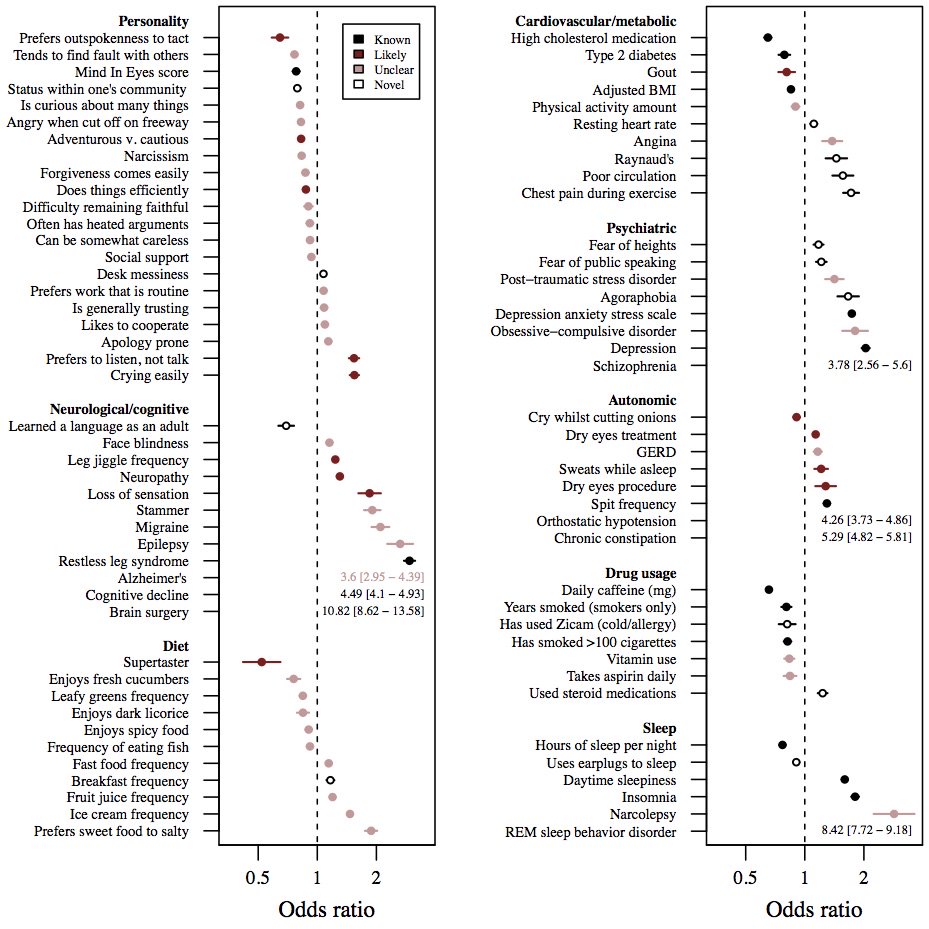
The Parkinson's Phenome: Traits Associated with Parkinson's Disease in a Large and Deeply Phenotyped Cohort

This is one of the first collaborative endeavours between Karl Heilbron (23andMe) and I... and I hope one of many. I have to say Karl did the bulk of the leg work and I was grateful for the opportunity to help pull it all together...

These data from 23andMe offer unparalleled opportunity to explore reported associations with Parkinson's. Using a rigorous pipeline for selecting phenotypic traits (self reported health conditions, dietary preferences, non-motor symptoms etc) we were able to produce an incredibly detailed exploration of the Parkinson's phenome (the sum total of Parkinson's associated traits). One of the fascinating things about the results is that many of the traits are instantly recognisable to those of us that see patients with Parkinson's regularly... this in turn increases our confidence about the novel associations that we observed and which offer further avenue for further research.

Additionally, where possible each trait was tested to if it was associated with disease duration, thereby suggesting that it might be a manifestation of disease rather than a risk factor or prodromal feature. Of course cross-sectional data has limitations when it comes to understanding cause and effect, but for the clinical neurologist seeing patients with PD this report of co-existing symptoms, behaviours and related health conditions could have huge practical use. The plan is to make all analyses available in order to stimulate further research in this area...

- Alastair Noyce

Karl Heilbron, Alastair Noyce, Pierre Fontanillas, Babak Alipanahi, The 23andMe Research Team, Mike Nalls, Paul Cannon

doi: https://doi.org/10.1101/270934

https://www.biorxiv.org/content/early/2018/02/28/270934

Background
Observational studies have begun to characterize the wide spectrum of phenotypes associated with Parkinson's disease (PD), but recruiting large numbers of PD cases and assaying a diversity of phenotypes has often been difficult. Here, we set out to systematically describe the PD phenome using a cross-sectional case-control design in a large database.

Methods
We analyzed the association between PD and 840 phenotypes derived from online surveys. For each phenotype, we ran a logistic regression using an average of 5,141 PD cases and 65,459 age- and sex-matched controls. We selected uncorrelated phenotypes, determined statistical significance after correcting for multiple testing, and systematically assessed the novelty of each significant association. We tested whether significant phenotypes were also associated with disease duration in PD cases.

Findings
PD diagnosis was associated with 149 independent phenotypes. We replicated 32 known associations and discovered 49 associations that have not previously been reported. We found that migraine, obsessive-compulsive disorder, seasonal allergies, and anemia were associated with PD, but were not significantly associated with PD duration, and tend to occur decades before the average age of diagnosis for PD. Further work is needed to determine whether these phenotypes are PD risk factors or whether they share common disease mechanisms.

Interpretation
We used a systematic approach in a single large dataset to assess the spectrum of traits that were associated with PD. Some of these traits may be risk factors for PD, features of the pre-diagnostic phase of disease, or manifestations of PD pathology. The model outputs from all 840 logistic regressions are available to the research community and may be used to generate hypotheses regarding PD etiology.

Funding
The Michael J. Fox Foundation, Parkinson's UK, Barts Charity, National Institute on Aging, and 23andMe, Inc.

Mild Parkinsonian Signs in a Community Population

One question that many of the PREDICT-PD participants ask me is “I am slower than I used to be, does it mean that I am getting Parkinson’...