Following on nicely from our last post, we are delighted to publicise our latest peer-reviewed publication.
This will come out in a special edition of the European Journal of Neuroscience, dedicated to the memory of Tom Isaacs. Tom was the founder and leader of the Cure Parkinson's Trust - a truly dynamic leader and a real disruptive presence (in all the right ways) within Parkinson's research. We are honoured to have our names and our ideas as testimonial to him in this way.
It is clear that Parkinson's is more of an umbrella condition than one single entity. For instance, some people have significant tremor, while others have none. Some progress very slowly, and a decade from diagnosis have barely any more symptoms - others progress more quickly. For many Parkinson's affects mainly movement while others have many non-motor symptoms. It is likely (although not yet proven) that these different subtypes of Parkinson's have a different underlying process causing them.
It therefore stands to reason that the earliest phases are also different. In our article we lay out the evidence that Parkinson's that comes from people with a particular kind of sleep disorder (REM sleep behavioural disorder), smell loss, and genetic forms do all look different. The evidence is not bomb-proof, but in Predict-PD we will be able to shed light on both the sleep disorder, smell loss and try and pick apart differences in the general population.
To see the article, please see the journal website. Please also remember to talk to friends and family to read more about the study and sign up themselves: www.predictpd.com
RNR
Showing posts with label phenotype. Show all posts
Showing posts with label phenotype. Show all posts
Sunday, 18 November 2018

Tuesday, 17 April 2018
Changing Tack
In a very wide ranging and well written review, two leaders of the
Parkinson’s field lay down set the terms of engagement and (to mix my combative
metaphors), lay down the gauntlet in the quest to find disease modifying
treatments.
After defining three kinds of ‘disease modification’ (neuroprotection:
preventing the progression of PD; neurorescue: repairing damaged brain cells;
neurorestoration: replacing what has been lost), they provide a brief but
comprehensive overview of why every attempt so far has failed, from both a
mechanistic perspective as well as a methodological perspective.
The key messages to take from this article are thus:
1.
We really need to stop thinking of Parkinson’s
as a single condition. As well as many different ways that people experience
their Parkinson’s (the different phenotypes), there are also many different
molecular and cellular processes. Each person will likely have a different
milieu of process that results in their particular phenotype.
2.
Once we can do this, we can start
approaching disease modification in a more personalised way. This means
recruiting the people with the right kind of Parkinson’s, at the right time, to
the right study. We need to become much more sophisticated in the way we study
new treatments, probably recruiting very specific groups of participants, for
example people with particular genetic changes related to their Parkinson’s, and
testing cocktails of treatments, rather than our current blunderbuss approach.
3.
Given that Parkinson’s is a complex, and
slowly progressive condition, we must have better progression markers on which
to design our studies.
This is going to require a lot of work, with the Parkinson’s
population, scientists, clinicians, and industry. In order to get the highly
effective treatments that our oncologists have avaiable to them, we need to
change the terms of warfare.
What can we all do in the mean time? Pay attention to these three
battles. Not necessarily throw the baby out with the bathwater if a particular
study doesn’t prove miraculous (which it almost certainly won’t). And if you
have Parkinson’s: exercise more!
At PREDICT-PD towers, we strongly believe that identifying the disease
earlier, in the prodromal phase, will bring us closer to many of these objectives.
Earlier disease is more likely to be simpler disease; it may be possible to identify
early phenotypes that map onto particular pathological pathways; we have an
opportunity to identify biomarkers that predict the development of established
Parkinson’s, thus giving an ideal method of proving efficacy of new treatments.
RNR
Disease modification in Parkinson's Disease: Current
approaches, challenges, and future considerations.
Anthony E Lang and Alberto J Espay.
Mov Disord, 2018 vol. 386 p. 896.
http://doi.wiley.com/10.1002/mds.27360
The greatest unmet therapeutic need in Parkinson's disease
is the development of treatment that slows the relentless progression of the
neurodegenerative process. The concept of "disease modification"
encompasses intervention types ranging from those designed to slow the
underlying degeneration to treatments directed at regenerating or replacing
lost neurons. To date all attempts to develop effective disease-modifying
therapy have failed. Many reasons have been proposed for these failures
including our rudimentary understanding of disease pathogenesis and the
assumption that each targeted mechanisms of disease apply to most patients with
the same clinical diagnosis. Here we review all aspects of this broad field
including general concepts and past challenges followed by a discussion of
treatment approaches under the following 4 categories: (1) α-synuclein, (2)
pathogenic mechanisms distinct from α-synuclein (most also potentially
triggered by α-synuclein toxicity), (3) non-SNCA genetic subtypes of "PD,"
and (4) possible disease-modifying interventions not directly influencing the
underlying PD pathobiology. We emphasize treatments that are currently under
active clinical development and highlight a wide range of important outstanding
questions and concerns that will need to be considered to advance the field of
disease modification in PD. Critically, it is unknown whether the dysfunctional
molecular pathways/organelles amenable to modification occur in a sequential
fashion across most clinically affected individuals or manifest differentially
in independent molecular subtypes of PD. It is possible that there is no
"order of disruption" applicable to most patients but, rather,
"type of disruption" applicable to subtypes dependent on unknown factors,
including genetic variability and other causes for heterogeneity in PD. Knowing
when (early vs late), which (eg, synaptic transmission, endosomal sorting and
maturation, lysosomal degradation, mitochondrial biogenesis), and in whom (PD
subtype) specific disrupted cell pathways are truly pathogenic versus
compensatory or even protective, will be important in considering the use of
single or combined ("cocktails") putative disease-modifying therapies
to selectively target these processes. Beyond the current phase 2 or 3 studies
underway evaluating treatments directed at oxidative stress (inosine),
cytosolic Ca2+ (isradipine), iron (deferiprone), and extracellular α-synuclein
(passive immunization), and upcoming trials of interventions affecting c-Abl,
glucagon-like peptide-1, and glucocerebrosidase, it might be argued that
further trials in populations not enriched for the targeted pathogenic process
are doomed to repeat the failures of the past. © 2018 International Parkinson
and Movement Disorder Society.
Friday, 23 March 2018
The Parkinson's Phenome: Traits Associated with Parkinson's Disease in a Large and Deeply Phenotyped Cohort
This is one of the first collaborative endeavours between Karl Heilbron (23andMe) and I... and I hope one of many. I have to say Karl did the bulk of the leg work and I was grateful for the opportunity to help pull it all together...
These data from 23andMe offer unparalleled opportunity to explore reported associations with Parkinson's. Using a rigorous pipeline for selecting phenotypic traits (self reported health conditions, dietary preferences, non-motor symptoms etc) we were able to produce an incredibly detailed exploration of the Parkinson's phenome (the sum total of Parkinson's associated traits). One of the fascinating things about the results is that many of the traits are instantly recognisable to those of us that see patients with Parkinson's regularly... this in turn increases our confidence about the novel associations that we observed and which offer further avenue for further research.
Additionally, where possible each trait was tested to if it was associated with disease duration, thereby suggesting that it might be a manifestation of disease rather than a risk factor or prodromal feature. Of course cross-sectional data has limitations when it comes to understanding cause and effect, but for the clinical neurologist seeing patients with PD this report of co-existing symptoms, behaviours and related health conditions could have huge practical use. The plan is to make all analyses available in order to stimulate further research in this area...
- Alastair Noyce
Karl Heilbron, Alastair Noyce, Pierre Fontanillas, Babak Alipanahi, The 23andMe Research Team, Mike Nalls, Paul Cannon
doi: https://doi.org/10.1101/270934
https://www.biorxiv.org/content/early/2018/02/28/270934
Background
Observational studies have begun to characterize the wide spectrum of phenotypes associated with Parkinson's disease (PD), but recruiting large numbers of PD cases and assaying a diversity of phenotypes has often been difficult. Here, we set out to systematically describe the PD phenome using a cross-sectional case-control design in a large database.
Methods
We analyzed the association between PD and 840 phenotypes derived from online surveys. For each phenotype, we ran a logistic regression using an average of 5,141 PD cases and 65,459 age- and sex-matched controls. We selected uncorrelated phenotypes, determined statistical significance after correcting for multiple testing, and systematically assessed the novelty of each significant association. We tested whether significant phenotypes were also associated with disease duration in PD cases.
Findings
PD diagnosis was associated with 149 independent phenotypes. We replicated 32 known associations and discovered 49 associations that have not previously been reported. We found that migraine, obsessive-compulsive disorder, seasonal allergies, and anemia were associated with PD, but were not significantly associated with PD duration, and tend to occur decades before the average age of diagnosis for PD. Further work is needed to determine whether these phenotypes are PD risk factors or whether they share common disease mechanisms.
Interpretation
We used a systematic approach in a single large dataset to assess the spectrum of traits that were associated with PD. Some of these traits may be risk factors for PD, features of the pre-diagnostic phase of disease, or manifestations of PD pathology. The model outputs from all 840 logistic regressions are available to the research community and may be used to generate hypotheses regarding PD etiology.
Funding
The Michael J. Fox Foundation, Parkinson's UK, Barts Charity, National Institute on Aging, and 23andMe, Inc.
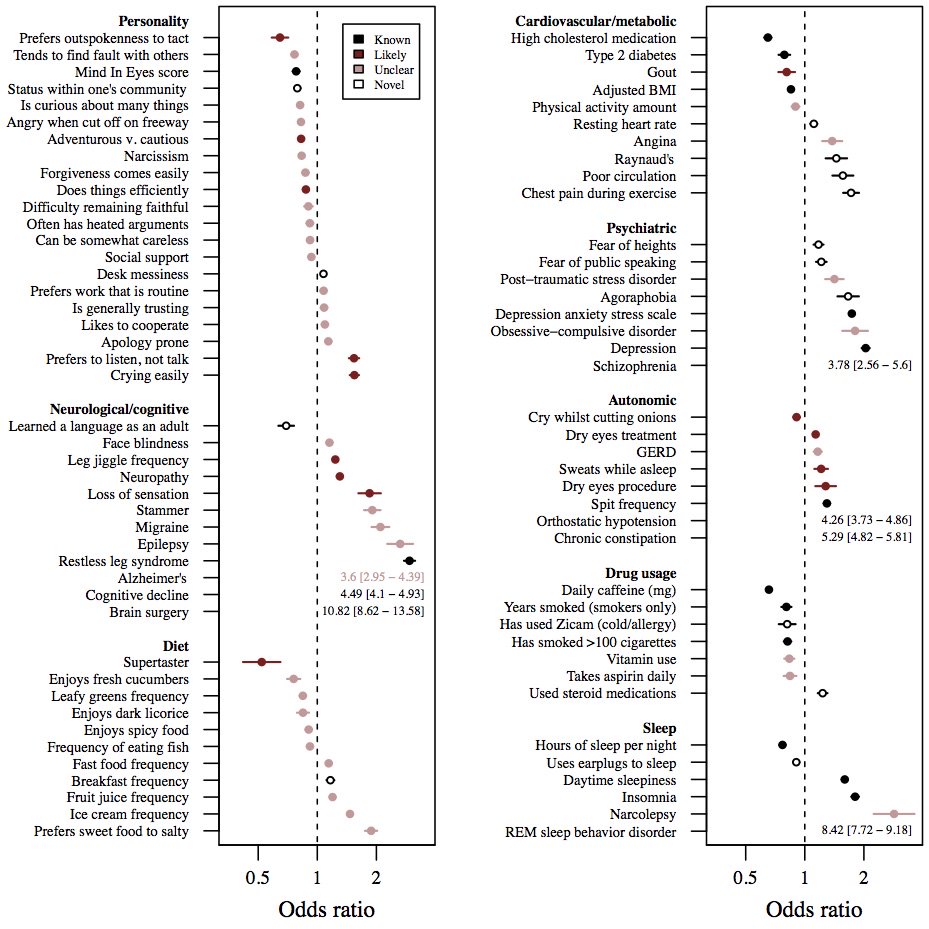
These data from 23andMe offer unparalleled opportunity to explore reported associations with Parkinson's. Using a rigorous pipeline for selecting phenotypic traits (self reported health conditions, dietary preferences, non-motor symptoms etc) we were able to produce an incredibly detailed exploration of the Parkinson's phenome (the sum total of Parkinson's associated traits). One of the fascinating things about the results is that many of the traits are instantly recognisable to those of us that see patients with Parkinson's regularly... this in turn increases our confidence about the novel associations that we observed and which offer further avenue for further research.
Additionally, where possible each trait was tested to if it was associated with disease duration, thereby suggesting that it might be a manifestation of disease rather than a risk factor or prodromal feature. Of course cross-sectional data has limitations when it comes to understanding cause and effect, but for the clinical neurologist seeing patients with PD this report of co-existing symptoms, behaviours and related health conditions could have huge practical use. The plan is to make all analyses available in order to stimulate further research in this area...
- Alastair Noyce
Karl Heilbron, Alastair Noyce, Pierre Fontanillas, Babak Alipanahi, The 23andMe Research Team, Mike Nalls, Paul Cannon
doi: https://doi.org/10.1101/270934
https://www.biorxiv.org/content/early/2018/02/28/270934
Background
Observational studies have begun to characterize the wide spectrum of phenotypes associated with Parkinson's disease (PD), but recruiting large numbers of PD cases and assaying a diversity of phenotypes has often been difficult. Here, we set out to systematically describe the PD phenome using a cross-sectional case-control design in a large database.
Methods
We analyzed the association between PD and 840 phenotypes derived from online surveys. For each phenotype, we ran a logistic regression using an average of 5,141 PD cases and 65,459 age- and sex-matched controls. We selected uncorrelated phenotypes, determined statistical significance after correcting for multiple testing, and systematically assessed the novelty of each significant association. We tested whether significant phenotypes were also associated with disease duration in PD cases.
Findings
PD diagnosis was associated with 149 independent phenotypes. We replicated 32 known associations and discovered 49 associations that have not previously been reported. We found that migraine, obsessive-compulsive disorder, seasonal allergies, and anemia were associated with PD, but were not significantly associated with PD duration, and tend to occur decades before the average age of diagnosis for PD. Further work is needed to determine whether these phenotypes are PD risk factors or whether they share common disease mechanisms.
Interpretation
We used a systematic approach in a single large dataset to assess the spectrum of traits that were associated with PD. Some of these traits may be risk factors for PD, features of the pre-diagnostic phase of disease, or manifestations of PD pathology. The model outputs from all 840 logistic regressions are available to the research community and may be used to generate hypotheses regarding PD etiology.
Funding
The Michael J. Fox Foundation, Parkinson's UK, Barts Charity, National Institute on Aging, and 23andMe, Inc.
Subscribe to:
Posts (Atom)