Showing posts with label diet. Show all posts

Monday, 24 December 2018

A few personal thoughts to round the year off.

At Predict-PD Towers we have had a busy and successful year. We have rebuilt the website from scratch, taking the opportunity to really review all the questions in the surveys, and select the very best questions to help us answer our research questions. We have pioneered new techniques that are now included in the website, including an online trailmaking task and making the tap-test even better. We have made excellent progress with the imaging substudy: selecting some high risk and similar low risk controls to see if we can see some of the early changes associated with Parkinson’s using cutting edge MRI techniques. We’ve been travelling the length and breadth of the country seeing many of the participants in our ‘special groups’: people with smell loss, and people with a certain kind of sleep disorder, to conduct physical and cognitive examinations in their own homes. We have grown our team allowing us to do similar in person assessments in the homes of many of our ‘regular’ participants, and now have some specialist statistical and techincal data management help. Most crucially of all, we have launched the second phase of the study, in which we aim to recruit 10,000 new participants aged 60-80 – please spread the word, and encourage as many friends and relatives to head to the website (www.predictpd.com) and consider taking part. It takes only about 25 minutes and could potentially change the future of Parkinson’s disease.

I also wanted to reflect on the festive period and what advice or suggestions I could make to individuals or families with someone who has Parkinson’s.

Christmas is a time for family and celebration. When someone has Parkinson’s not only can movement be slow, but many non-motor symptoms can make this time of year hard. Depression, apathy and difficulty keeping up with conversations can make participation in family events so much harder. If Parkinson’s affects your family, friends or neighbours, please try and make the effort not to leave them behind. Social and physical exercise are vital to people with Parkinson’s, so make the effort to make that easy. The post-Christmas lunch walk may doesn’t need to be fast, but by making it inclusive you’ll make a real difference.

Another, far less pleasant aspect of this time of year, is flu. Flu continues to be a significant cause of illness and even death, and although there is no magic bullet, for many people it is potentially preventable. The simplest things are the most effective: handwashing with soap and water (especially after using public transport, before eating, and after coughing and sneezing), using disposable tissues (catch it, bin it, kill it), and the flu jab. It is worth busting a few common flu-jab myths: the immunisation does not contain the live virus – therefore you cannot catch the flu from the jab. While the recommended time to have the jab is October – November, flu cases continue to be common all the way through to the end of March, so better late than never. Each year the vaccine covers different strains of the flu, so that is why it is recommended to have it every year. This also means that the vaccine won’t protect you from evey strain  of flu (there are hundreds), but it will protect you from the ones that are likely to be the most common each year. Being otherwise healthy doesn’t protect you: despite running around 50 miles a week and generally enjoying excellent health, I’ve had a grotty end to the year, with the flu, which then predisposed me to pneumonia (and as a responsible health professional, yes I did get the jab in October, but that just means I was unlucky, and would still recommend it). 

We are of course indebted and grateful to Parkinson's UK for the funding that has allowed us to do this research, and for the support they continue to give. I'm looking forward to my first training run on Christmas day for the London Marathon, where I'll be aiming to break both my targets: under 3 hour finishing time and over £2500 for Parkinson's UK (http://bit.ly/RNR4Parkinsons for those that are interested).

Finally, from the entire team at Predict-PD, we thank you for your interest and participation throughout this year, and wish you and your family a very merry Christmas, and a happy and healthy 2019.

RNR

Friday, 23 March 2018

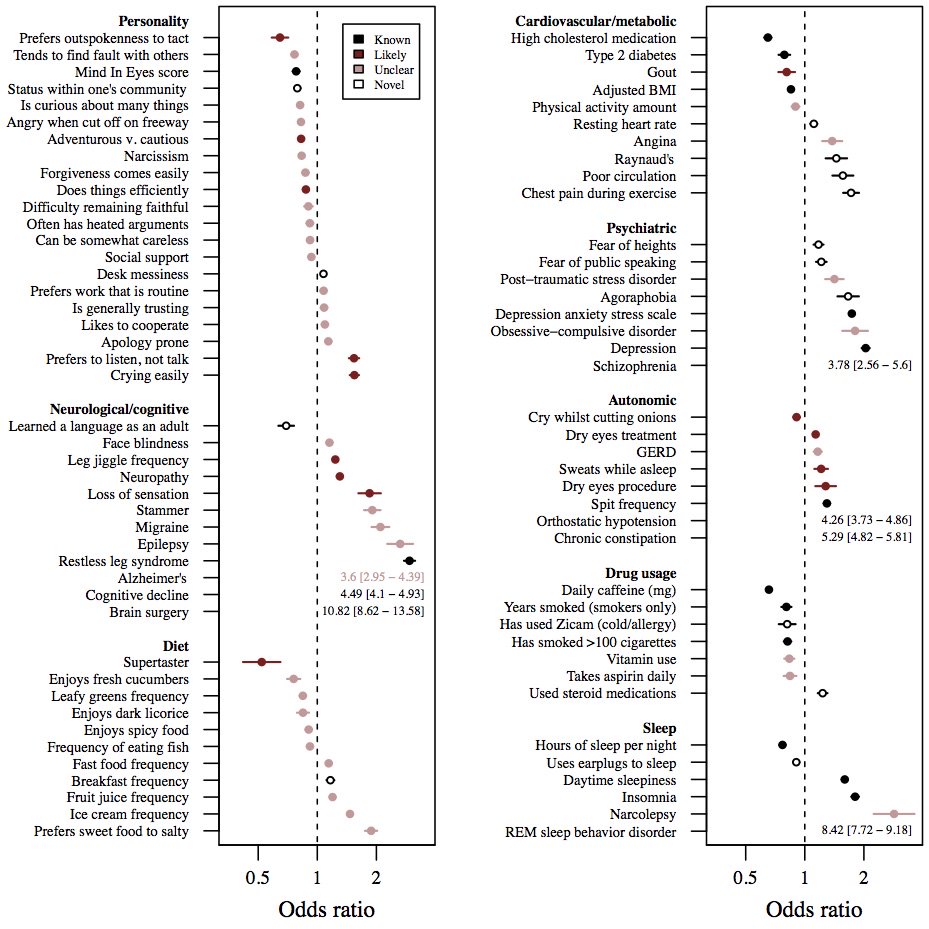
The Parkinson's Phenome: Traits Associated with Parkinson's Disease in a Large and Deeply Phenotyped Cohort

This is one of the first collaborative endeavours between Karl Heilbron (23andMe) and I... and I hope one of many. I have to say Karl did the bulk of the leg work and I was grateful for the opportunity to help pull it all together...

These data from 23andMe offer unparalleled opportunity to explore reported associations with Parkinson's. Using a rigorous pipeline for selecting phenotypic traits (self reported health conditions, dietary preferences, non-motor symptoms etc) we were able to produce an incredibly detailed exploration of the Parkinson's phenome (the sum total of Parkinson's associated traits). One of the fascinating things about the results is that many of the traits are instantly recognisable to those of us that see patients with Parkinson's regularly... this in turn increases our confidence about the novel associations that we observed and which offer further avenue for further research.

Additionally, where possible each trait was tested to if it was associated with disease duration, thereby suggesting that it might be a manifestation of disease rather than a risk factor or prodromal feature. Of course cross-sectional data has limitations when it comes to understanding cause and effect, but for the clinical neurologist seeing patients with PD this report of co-existing symptoms, behaviours and related health conditions could have huge practical use. The plan is to make all analyses available in order to stimulate further research in this area...

- Alastair Noyce

Karl Heilbron, Alastair Noyce, Pierre Fontanillas, Babak Alipanahi, The 23andMe Research Team, Mike Nalls, Paul Cannon

doi: https://doi.org/10.1101/270934

https://www.biorxiv.org/content/early/2018/02/28/270934

Background
Observational studies have begun to characterize the wide spectrum of phenotypes associated with Parkinson's disease (PD), but recruiting large numbers of PD cases and assaying a diversity of phenotypes has often been difficult. Here, we set out to systematically describe the PD phenome using a cross-sectional case-control design in a large database.

Methods
We analyzed the association between PD and 840 phenotypes derived from online surveys. For each phenotype, we ran a logistic regression using an average of 5,141 PD cases and 65,459 age- and sex-matched controls. We selected uncorrelated phenotypes, determined statistical significance after correcting for multiple testing, and systematically assessed the novelty of each significant association. We tested whether significant phenotypes were also associated with disease duration in PD cases.

Findings
PD diagnosis was associated with 149 independent phenotypes. We replicated 32 known associations and discovered 49 associations that have not previously been reported. We found that migraine, obsessive-compulsive disorder, seasonal allergies, and anemia were associated with PD, but were not significantly associated with PD duration, and tend to occur decades before the average age of diagnosis for PD. Further work is needed to determine whether these phenotypes are PD risk factors or whether they share common disease mechanisms.

Interpretation
We used a systematic approach in a single large dataset to assess the spectrum of traits that were associated with PD. Some of these traits may be risk factors for PD, features of the pre-diagnostic phase of disease, or manifestations of PD pathology. The model outputs from all 840 logistic regressions are available to the research community and may be used to generate hypotheses regarding PD etiology.

Funding
The Michael J. Fox Foundation, Parkinson's UK, Barts Charity, National Institute on Aging, and 23andMe, Inc.

Mild Parkinsonian Signs in a Community Population

One question that many of the PREDICT-PD participants ask me is “I am slower than I used to be, does it mean that I am getting Parkinson’...