Following on nicely from our last post, we are delighted to publicise our latest peer-reviewed publication.
This will come out in a special edition of the European Journal of Neuroscience, dedicated to the memory of Tom Isaacs. Tom was the founder and leader of the Cure Parkinson's Trust - a truly dynamic leader and a real disruptive presence (in all the right ways) within Parkinson's research. We are honoured to have our names and our ideas as testimonial to him in this way.
It is clear that Parkinson's is more of an umbrella condition than one single entity. For instance, some people have significant tremor, while others have none. Some progress very slowly, and a decade from diagnosis have barely any more symptoms - others progress more quickly. For many Parkinson's affects mainly movement while others have many non-motor symptoms. It is likely (although not yet proven) that these different subtypes of Parkinson's have a different underlying process causing them.
It therefore stands to reason that the earliest phases are also different. In our article we lay out the evidence that Parkinson's that comes from people with a particular kind of sleep disorder (REM sleep behavioural disorder), smell loss, and genetic forms do all look different. The evidence is not bomb-proof, but in Predict-PD we will be able to shed light on both the sleep disorder, smell loss and try and pick apart differences in the general population.
To see the article, please see the journal website. Please also remember to talk to friends and family to read more about the study and sign up themselves: www.predictpd.com
RNR
Showing posts with label non-motor. Show all posts
Showing posts with label non-motor. Show all posts
Sunday, 18 November 2018

Friday, 9 November 2018
Why does Parkinson's cause constipation?
When people think of Parkinson's disease they often think of tremors however often people who actually have Parkinson's are more concerned by the symptoms that are not to do with movement and tremors (non-motor symptoms). The commonest of these symptoms are constipation, tiredness, difficulty sleeping, anxiety and needing to pass urine multiple times at night. These symptoms are not always as immediately obvious to people without Parkinson's but they can be extremely troubling. In this blog I want to talk a bit more about constipation and why people with Parkinson's get constipation.
Constipation is when it is more difficult to go for a poo or when the amount of time between opening your bowels increases. Usually your poo will become a lot harder when this happens and sometimes can result in a bloated feeling and pain in your tummy. So the question is how does Parkinson's, a brain disease, affect your bowels in this way?
The answer lies in looking at the large intestine. This is a large pipe near the end of the path from your mouth to your bum (the GI tract). By the time your dinner reaches the large colon it has mainly been digested and had all of the useful vitamins, protein and carbohydrates removed from it. This means that when your dinner reaches the large colon it is made up of waste products (poo) and lots of water; in fact it is so watery at this point that it is completely liquid. The role of the large colon is to turn this liquid into a solid poo and to get the water out of it so that you can stay hydrated. So what changes in Parkinson's disease?
In Parkinson's disease if you measure the amount of time it takes a piece of food to move from the beginning of the large intestine to exiting out of your bum it would take double the amount of time that it would take a healthy person. In other words: poo moves through the large intestine at half the speed if you have Parkinson's. Because the large intestine is so good at draining water from your poo, the poo becomes much drier and harder as the large intestine has double the amount of time to remove as much water as possible. This explains why people with Parkinson's have drier harder poos and subsequently have more constipation.
The large intestine pushes food along it by tensing the muscles around it in a rhythmic way that propels the poo downstream. Like the rest of the body, in Parkinson's, these movements become much slower. The reason for this is not as clear but is probably due to the layer of nerve cells around the gut wall called the enteric nervous system. Studies where they have looked at samples of the gut wall have found build ups of Lewy Bodies (the characteristic thing found in the brain in Parkinson's) also in the gut wall. It is possible that this build up is what also causes the slowness in the gut.
It is important to remember that there are many other things that cause constipation other than Parkinson's. There are many medications that can be tried to help improve constipation but some of the simple things that can help are increasing the amount of water you drink or increasing the amount of fibre that you eat, but discuss with your doctor if this is a problem for you.
Constipation is when it is more difficult to go for a poo or when the amount of time between opening your bowels increases. Usually your poo will become a lot harder when this happens and sometimes can result in a bloated feeling and pain in your tummy. So the question is how does Parkinson's, a brain disease, affect your bowels in this way?
The answer lies in looking at the large intestine. This is a large pipe near the end of the path from your mouth to your bum (the GI tract). By the time your dinner reaches the large colon it has mainly been digested and had all of the useful vitamins, protein and carbohydrates removed from it. This means that when your dinner reaches the large colon it is made up of waste products (poo) and lots of water; in fact it is so watery at this point that it is completely liquid. The role of the large colon is to turn this liquid into a solid poo and to get the water out of it so that you can stay hydrated. So what changes in Parkinson's disease?
In Parkinson's disease if you measure the amount of time it takes a piece of food to move from the beginning of the large intestine to exiting out of your bum it would take double the amount of time that it would take a healthy person. In other words: poo moves through the large intestine at half the speed if you have Parkinson's. Because the large intestine is so good at draining water from your poo, the poo becomes much drier and harder as the large intestine has double the amount of time to remove as much water as possible. This explains why people with Parkinson's have drier harder poos and subsequently have more constipation.
The large intestine pushes food along it by tensing the muscles around it in a rhythmic way that propels the poo downstream. Like the rest of the body, in Parkinson's, these movements become much slower. The reason for this is not as clear but is probably due to the layer of nerve cells around the gut wall called the enteric nervous system. Studies where they have looked at samples of the gut wall have found build ups of Lewy Bodies (the characteristic thing found in the brain in Parkinson's) also in the gut wall. It is possible that this build up is what also causes the slowness in the gut.
It is important to remember that there are many other things that cause constipation other than Parkinson's. There are many medications that can be tried to help improve constipation but some of the simple things that can help are increasing the amount of water you drink or increasing the amount of fibre that you eat, but discuss with your doctor if this is a problem for you.
Curr
Treat Options Neurol. 2018 Oct 25;20(12):54. doi:
10.1007/s11940-018-0539-9.
Gastrointestinal
Dysfunction in Parkinson's Disease.
Pfeiffer
RF
Author information
Abstract
PURPOSE OF REVIEW:
During the past
25 years, there has been an explosion of information regarding the
occurrence of gastrointestinal dysfunction in Parkinson's disease. In
this review, the clinical features of gastrointestinal dysfunction in Parkinson's disease will
be described and information regarding the potential role of the enteric
nervous system and the gut microbiome in the genesis of Parkinson's disease will
be addressed.
RECENT FINDINGS:
Recognition is
growing regarding the role that gastroparesis and small intestinal dysfunction
may play in Parkinson's disease, especially with regard to erratic
responses to anti-Parkinson medication. The presence of enteric nervous
system involvement in Parkinson's disease is now well
established, but whether the enteric nervous system is the starting point
for Parkinson's disease pathology remains a source of debate.
The potential role of the gut microbiome also is beginning to emerge.
Gastrointestinal dysfunction is a prominent nonmotor feature of Parkinson's disease and
dysfunction can be found along the entire length of the gastrointestinal tract.
The enteric nervous system is clearly involved in Parkinson's disease.
Whether it is the initial source of pathology is still a source of controversy.
There also is growing recognition of the role that the gut microbiome may play
in Parkinson's disease, but much more research is needed to fully
assess this aspect of the disorder.
Wednesday, 30 May 2018
Plain English - Low body mass index and life prognosis in Parkinson's disease
Over the last few years we have seen research that suggests being underweight has a negative or detrimental effect on survival with diseases like Parkinson's. The same has been shown for motor neurone disease and Alzheimer's. Whether this reflects a more aggressive form of the disease, which in itself also affects weight, or whether being a bit heavier makes you a bit more 'robust' to these diseases remains to be seen.
In this study the authors show something similar. When they looked backwards in time in a large number of patients with Parkinson's, they saw that those that were underweight had survived for a shorter time than those that were normal weight or over weight. We must be cautious in how we interpret the results because they don't necessarily suggest that being heavier is better and indeed obesity causes an increase in heart and vascular disease, diabetes, and cancer. However it does suggest that being underweight and having Parkinson's is not a good idea either. Aiming for a recommended normal weight and BMI (body mass index) appears to offer the best option considering all outcomes.
The reason I am particularly interested in this study is because last year we published research showing that higher BMI appears to protect you against Parkinson's. The special thing about the analysis that we did was that it assessed the effect that BMI has on Parkinson's (BMI -> Parkinson's) without being affected by the effect that Parkinson's has on BMI (Parkinson's -> BMI). The method we used was called Mendelian randomisation and it is increasingly used to assess whether risk factors cause a disease as opposed to simply being associated.
The relationship between weight and BMI and Parkinson's disease is complicated and is an important area for further study.
- Alastair Noyce
Parkinsonism Relat Disord. 2018 May 15. pii: S1353-8020(18)30241-4. doi: 10.1016/j.parkreldis.2018.05.011. [Epub ahead of print]
Park K, Oeda T, Kohsaka M, Tomita S, Umemura A, Sawada H.
https://www.prd-journal.com/article/S1353-8020(18)30241-4/fulltext
INTRODUCTION: Patients with Parkinson's disease (PD) frequently lose weight, even in the early stages of the disease. Our objective was to clarify the association between low body mass index (BMI) and life prognosis in PD.
METHODS: We conducted a retrospective cohort study of 651 PD patients (380 females), with a primary endpoint of survival. Because of sex differences in BMI, male and female data were separated. We compared survival times between underweight (BMI < 18.5) and non-underweight (BMI ≥ 18.5) patients and calculated hazard ratios (HRs) adjusted for other relevant factors. To investigate the semi-quantitative relationship between relative risk of death and BMI, we divided patients into lower, middle, and upper thirds of BMI and calculated the HRs of the lower and upper thirds, with reference to the middle third.
RESULTS: Seventy-nine patients (41 females) died over a mean (standard deviation) observation period of 39 (26) months. Underweight patients had poorer life prognosis than non-underweight patients and the difference was larger in males than in females (adjusted HR 3.8 (95% confidence interval 1.9-7.9) in males and 1.8 (0.9-3.5) in females). In males, the relationship between survival and BMI was much poorer in the bottom third and slightly poorer in the top third compared with the middle third. In females, the higher the BMI, the better the survival prognosis; however, the difference was not statistically significant.
CONCLUSION: Low BMI had a significant impact on the life prognosis of PD patients, especially males.

In this study the authors show something similar. When they looked backwards in time in a large number of patients with Parkinson's, they saw that those that were underweight had survived for a shorter time than those that were normal weight or over weight. We must be cautious in how we interpret the results because they don't necessarily suggest that being heavier is better and indeed obesity causes an increase in heart and vascular disease, diabetes, and cancer. However it does suggest that being underweight and having Parkinson's is not a good idea either. Aiming for a recommended normal weight and BMI (body mass index) appears to offer the best option considering all outcomes.
The reason I am particularly interested in this study is because last year we published research showing that higher BMI appears to protect you against Parkinson's. The special thing about the analysis that we did was that it assessed the effect that BMI has on Parkinson's (BMI -> Parkinson's) without being affected by the effect that Parkinson's has on BMI (Parkinson's -> BMI). The method we used was called Mendelian randomisation and it is increasingly used to assess whether risk factors cause a disease as opposed to simply being associated.
The relationship between weight and BMI and Parkinson's disease is complicated and is an important area for further study.
- Alastair Noyce
Parkinsonism Relat Disord. 2018 May 15. pii: S1353-8020(18)30241-4. doi: 10.1016/j.parkreldis.2018.05.011. [Epub ahead of print]
Park K, Oeda T, Kohsaka M, Tomita S, Umemura A, Sawada H.
https://www.prd-journal.com/article/S1353-8020(18)30241-4/fulltext
INTRODUCTION: Patients with Parkinson's disease (PD) frequently lose weight, even in the early stages of the disease. Our objective was to clarify the association between low body mass index (BMI) and life prognosis in PD.
METHODS: We conducted a retrospective cohort study of 651 PD patients (380 females), with a primary endpoint of survival. Because of sex differences in BMI, male and female data were separated. We compared survival times between underweight (BMI < 18.5) and non-underweight (BMI ≥ 18.5) patients and calculated hazard ratios (HRs) adjusted for other relevant factors. To investigate the semi-quantitative relationship between relative risk of death and BMI, we divided patients into lower, middle, and upper thirds of BMI and calculated the HRs of the lower and upper thirds, with reference to the middle third.
RESULTS: Seventy-nine patients (41 females) died over a mean (standard deviation) observation period of 39 (26) months. Underweight patients had poorer life prognosis than non-underweight patients and the difference was larger in males than in females (adjusted HR 3.8 (95% confidence interval 1.9-7.9) in males and 1.8 (0.9-3.5) in females). In males, the relationship between survival and BMI was much poorer in the bottom third and slightly poorer in the top third compared with the middle third. In females, the higher the BMI, the better the survival prognosis; however, the difference was not statistically significant.
CONCLUSION: Low BMI had a significant impact on the life prognosis of PD patients, especially males.

Friday, 30 March 2018
Keep it simple..
Predictive medicine is becoming increasingly complex, with predictive models which incorporate both clinical information and a huge range of biomarkers. Biomarkers commonly used in neurodegenerative disease include molecules in bodily fluids such as saliva, blood and spinal fluid and genetic data from these sources, scans for both structural aspects of the brain and molecular studies which can quantify the amount of protein build up in the brain. These biomarkers vary in how invasive and risky they are to collect and while they may help us understand the disease process, many people are uncomfortable with going through an invasive procedure such as lumbar puncture.
The basis of the current PREDICT-PD model is to use participant survey to collect clinical information to predict risk. The study below, from a team in Quebec, also uses a clinical approach. They looked at a group of people with Parkinsons' disease and used an 8 item scoring scale including age, evidence of cognitive impairment at baseline, motor features such as freezing or falls, drop in blood pressure on standing and features of rapid eye movement sleep behaviour disorder.
Interestingly, the predictive value of this model seems to be as good as studies which include biomarker values such as amyloid protein levels in the spinal fluid. Biomarker studies in this area will continue to be important, especially as they hold the hope of elucidating the molecular processes which can be interrupted to disrupt the progression of disease. But this is a good reminder of the power that can be harnessed from information which is available simply by asking questions of and examining our patients.
-Anna
Office-Based Screening for Dementia in Parkinson Disease: The Montreal Parkinson Risk of Dementia Scale in 4 Longitudinal Cohorts.
IMPORTANCE:
Parkinson disease dementia dramatically increases mortality rates, patient expenditures, hospitalization risk, and caregiver burden. Currently, predicting Parkinson disease dementia risk is difficult, particularly in an office-based setting, without extensive biomarker testing.
OBJECTIVE:
To appraise the predictive validity of the Montreal Parkinson Risk of Dementia Scale, an office-based screening tool consisting of 8 items that are simply assessed.
DESIGN, SETTING, AND PARTICIPANTS:
This multicenter study (Montreal, Canada; Tottori, Japan; and Parkinson Progression Markers Initiative sites) used 4 diverse Parkinson disease cohorts with a prospective 4.4-year follow-up. A total of 717 patients with Parkinson disease were recruited between May 2005 and June 2016. Of these, 607 were dementia-free at baseline and followed-up for 1 year or more and so were included. The association of individual baseline scale variables with eventual dementia risk was calculated. Participants were then randomly split into cohorts to investigate weighting and determine the scale's optimal cutoff point. Receiver operating characteristic curves were calculated and correlations with selected biomarkers were investigated.
MAIN OUTCOMES AND MEASURES:
Dementia, as defined by Movement Disorder Society level I criteria.
RESULTS:
Of the 607 patients (mean [SD] age, 63.4 [10.1]; 376 men [62%]), 70 (11.5%) converted to dementia. All 8 items of the Montreal Parkinson Risk of Dementia Scale independently predicted dementia development at the 5% significance level. The annual conversion rate to dementia in the high-risk group (score, >5) was 14.9% compared with 5.8% in the intermediate group (score, 4-5) and 0.6% in the low-risk group (score, 0-3). The weighting procedure conferred no significant advantage. Overall predictive validity by the area under the receiver operating characteristic curve was 0.877 (95% CI, 0.829-0.924) across all cohorts. A cutoff of 4 or greater yielded a sensitivity of 77.1% (95% CI, 65.6-86.3) and a specificity of 87.2% (95% CI, 84.1-89.9), with a positive predictive value (as of 4.4 years) of 43.90% (95% CI, 37.76-50.24) and a negative predictive value of 96.70% (95% CI, 95.01-97.85). Positive and negative likelihood ratios were 5.94 (95% CI, 4.08-8.65) and 0.26 (95% CI, 0.17-0.40), respectively. Scale results correlated with markers of Alzheimer pathology and neuropsychological test results.
CONCLUSIONS AND RELEVANCE:
Despite its simplicity, the Montreal Parkinson Risk of Dementia Scale demonstrated predictive validity equal or greater to previously described algorithms using biomarker assessments. Future studies using head-to-head comparisons or refinement of weighting would be of interest.
Friday, 23 March 2018
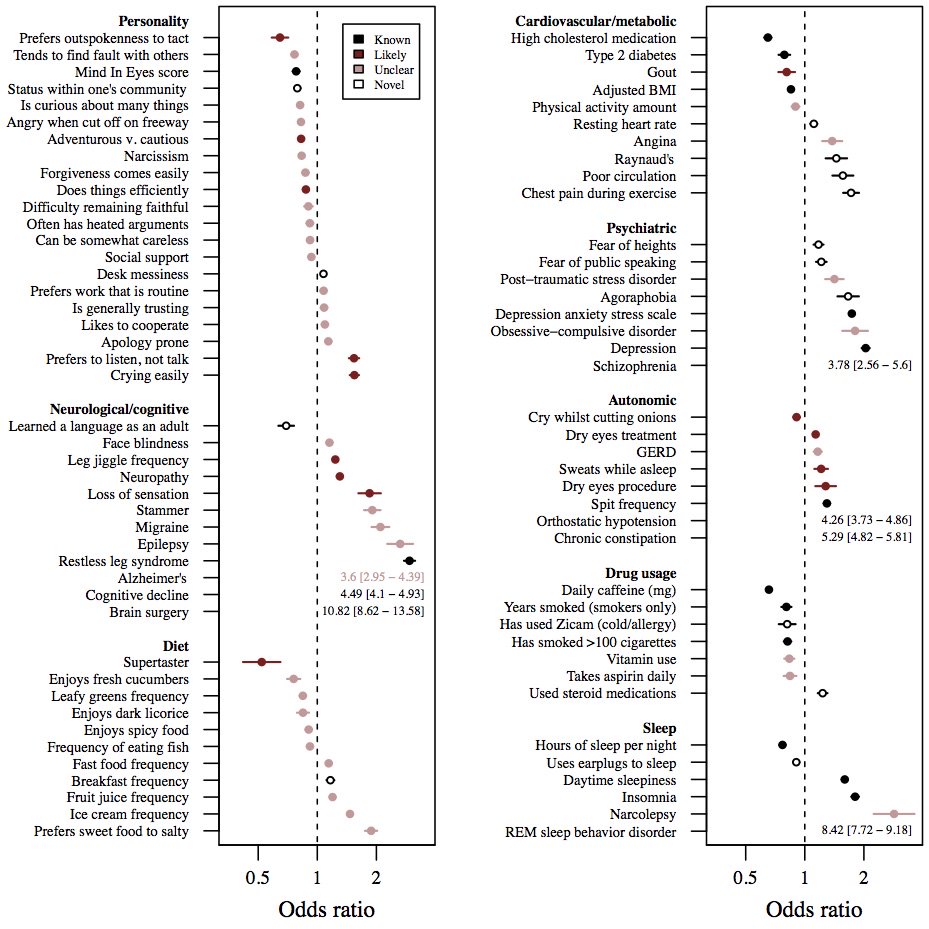
The Parkinson's Phenome: Traits Associated with Parkinson's Disease in a Large and Deeply Phenotyped Cohort
This is one of the first collaborative endeavours between Karl Heilbron (23andMe) and I... and I hope one of many. I have to say Karl did the bulk of the leg work and I was grateful for the opportunity to help pull it all together...
These data from 23andMe offer unparalleled opportunity to explore reported associations with Parkinson's. Using a rigorous pipeline for selecting phenotypic traits (self reported health conditions, dietary preferences, non-motor symptoms etc) we were able to produce an incredibly detailed exploration of the Parkinson's phenome (the sum total of Parkinson's associated traits). One of the fascinating things about the results is that many of the traits are instantly recognisable to those of us that see patients with Parkinson's regularly... this in turn increases our confidence about the novel associations that we observed and which offer further avenue for further research.
Additionally, where possible each trait was tested to if it was associated with disease duration, thereby suggesting that it might be a manifestation of disease rather than a risk factor or prodromal feature. Of course cross-sectional data has limitations when it comes to understanding cause and effect, but for the clinical neurologist seeing patients with PD this report of co-existing symptoms, behaviours and related health conditions could have huge practical use. The plan is to make all analyses available in order to stimulate further research in this area...
- Alastair Noyce
Karl Heilbron, Alastair Noyce, Pierre Fontanillas, Babak Alipanahi, The 23andMe Research Team, Mike Nalls, Paul Cannon
doi: https://doi.org/10.1101/270934
https://www.biorxiv.org/content/early/2018/02/28/270934
Background
Observational studies have begun to characterize the wide spectrum of phenotypes associated with Parkinson's disease (PD), but recruiting large numbers of PD cases and assaying a diversity of phenotypes has often been difficult. Here, we set out to systematically describe the PD phenome using a cross-sectional case-control design in a large database.
Methods
We analyzed the association between PD and 840 phenotypes derived from online surveys. For each phenotype, we ran a logistic regression using an average of 5,141 PD cases and 65,459 age- and sex-matched controls. We selected uncorrelated phenotypes, determined statistical significance after correcting for multiple testing, and systematically assessed the novelty of each significant association. We tested whether significant phenotypes were also associated with disease duration in PD cases.
Findings
PD diagnosis was associated with 149 independent phenotypes. We replicated 32 known associations and discovered 49 associations that have not previously been reported. We found that migraine, obsessive-compulsive disorder, seasonal allergies, and anemia were associated with PD, but were not significantly associated with PD duration, and tend to occur decades before the average age of diagnosis for PD. Further work is needed to determine whether these phenotypes are PD risk factors or whether they share common disease mechanisms.
Interpretation
We used a systematic approach in a single large dataset to assess the spectrum of traits that were associated with PD. Some of these traits may be risk factors for PD, features of the pre-diagnostic phase of disease, or manifestations of PD pathology. The model outputs from all 840 logistic regressions are available to the research community and may be used to generate hypotheses regarding PD etiology.
Funding
The Michael J. Fox Foundation, Parkinson's UK, Barts Charity, National Institute on Aging, and 23andMe, Inc.
These data from 23andMe offer unparalleled opportunity to explore reported associations with Parkinson's. Using a rigorous pipeline for selecting phenotypic traits (self reported health conditions, dietary preferences, non-motor symptoms etc) we were able to produce an incredibly detailed exploration of the Parkinson's phenome (the sum total of Parkinson's associated traits). One of the fascinating things about the results is that many of the traits are instantly recognisable to those of us that see patients with Parkinson's regularly... this in turn increases our confidence about the novel associations that we observed and which offer further avenue for further research.
Additionally, where possible each trait was tested to if it was associated with disease duration, thereby suggesting that it might be a manifestation of disease rather than a risk factor or prodromal feature. Of course cross-sectional data has limitations when it comes to understanding cause and effect, but for the clinical neurologist seeing patients with PD this report of co-existing symptoms, behaviours and related health conditions could have huge practical use. The plan is to make all analyses available in order to stimulate further research in this area...
- Alastair Noyce
Karl Heilbron, Alastair Noyce, Pierre Fontanillas, Babak Alipanahi, The 23andMe Research Team, Mike Nalls, Paul Cannon
doi: https://doi.org/10.1101/270934
https://www.biorxiv.org/content/early/2018/02/28/270934
Background
Observational studies have begun to characterize the wide spectrum of phenotypes associated with Parkinson's disease (PD), but recruiting large numbers of PD cases and assaying a diversity of phenotypes has often been difficult. Here, we set out to systematically describe the PD phenome using a cross-sectional case-control design in a large database.
Methods
We analyzed the association between PD and 840 phenotypes derived from online surveys. For each phenotype, we ran a logistic regression using an average of 5,141 PD cases and 65,459 age- and sex-matched controls. We selected uncorrelated phenotypes, determined statistical significance after correcting for multiple testing, and systematically assessed the novelty of each significant association. We tested whether significant phenotypes were also associated with disease duration in PD cases.
Findings
PD diagnosis was associated with 149 independent phenotypes. We replicated 32 known associations and discovered 49 associations that have not previously been reported. We found that migraine, obsessive-compulsive disorder, seasonal allergies, and anemia were associated with PD, but were not significantly associated with PD duration, and tend to occur decades before the average age of diagnosis for PD. Further work is needed to determine whether these phenotypes are PD risk factors or whether they share common disease mechanisms.
Interpretation
We used a systematic approach in a single large dataset to assess the spectrum of traits that were associated with PD. Some of these traits may be risk factors for PD, features of the pre-diagnostic phase of disease, or manifestations of PD pathology. The model outputs from all 840 logistic regressions are available to the research community and may be used to generate hypotheses regarding PD etiology.
Funding
The Michael J. Fox Foundation, Parkinson's UK, Barts Charity, National Institute on Aging, and 23andMe, Inc.
Subscribe to:
Posts (Atom)